Newsletter Subscribe
Enter your email address below and subscribe to our newsletter

Scroll through social media these days and it’s all too easy to get the wrong impression. Journeys are becoming more extreme, the gear is getting ever more outlandish, and the influencers are all too eager to tell us we need the latest gizmos to even call ourselves “overlanders.” Brands are practically begging us to empty our bank accounts, promising that the right kit will unlock the ultimate adventure. Everything is bigger, better, and often, let’s be honest, over-dramatised.
So, for someone contemplating their very first trip – which might just be a weekend adventure a few miles from home – the whole idea of overlanding can seem pretty daunting. What many seem to forget, or conveniently ignore, is that the heroes of 50, 60, or even 70 years ago didn’t have access to the advanced technology and accessories on offer today. But they still embarked on the wildest of adventures and reached their goals, relying on sheer grit and a healthy dose of ingenuity.
In a funny sort of way, everything is arse-about-face. Take “First Overland,” for example. Six university students left London in two Land Rover Series 1s and drove all the way to Singapore. They crossed deserts, fought their way through jungles, and carved their own path where roads didn’t exist. The Series 1 Land Rovers they used had four-wheel drive, skinny tyres, and an electric winch. The teams relied on paper maps and compasses, cameras with film, some basic tools and the simplest of camp equipment.
Today, almost anywhere you want to go can be reached on paved roads. The vehicles the modern-day overlander has to choose from come with driver-assist systems, software to tune the technology for the terrain you want to cover, and there are no end of modifications to make them higher, wider, and even more powerful. We have sat navs, digital cameras, and phones that have more technology packed into them than the Apollo mission that landed on the moon.
All today’s technology would have been welcome when the roads ran out 70 years ago, and the simplest of vehicles of an almost forgotten era are still capable of taking us wherever we want to go today… albeit at a slower pace and without the luxury we have grown accustomed to.
The internet is a wonderful resource: type in a question about any topic and we are rewarded with no end of wisdom (some good, some not so). If you research gear for overlanding you can be quickly overwhelmed by the number of brands and products on offer, especially if you are new to the concept of overlanding.
And that brings me to the reason behind this article. Overlanding should be exciting; it should be fun. It shouldn’t be overwhelming or a financial burden, even less so if you’re just figuring out if this is a hobby you wish to pursue. So why not take a leaf out of a book written by one of the early adventurers? If they could go off exploring and overcome the challenges they met along the way, without all the bells and whistles available to us today, then what’s stopping you or I doing the same? Or, do we really need the latest, most expensive of everything to have a good time? I think not.
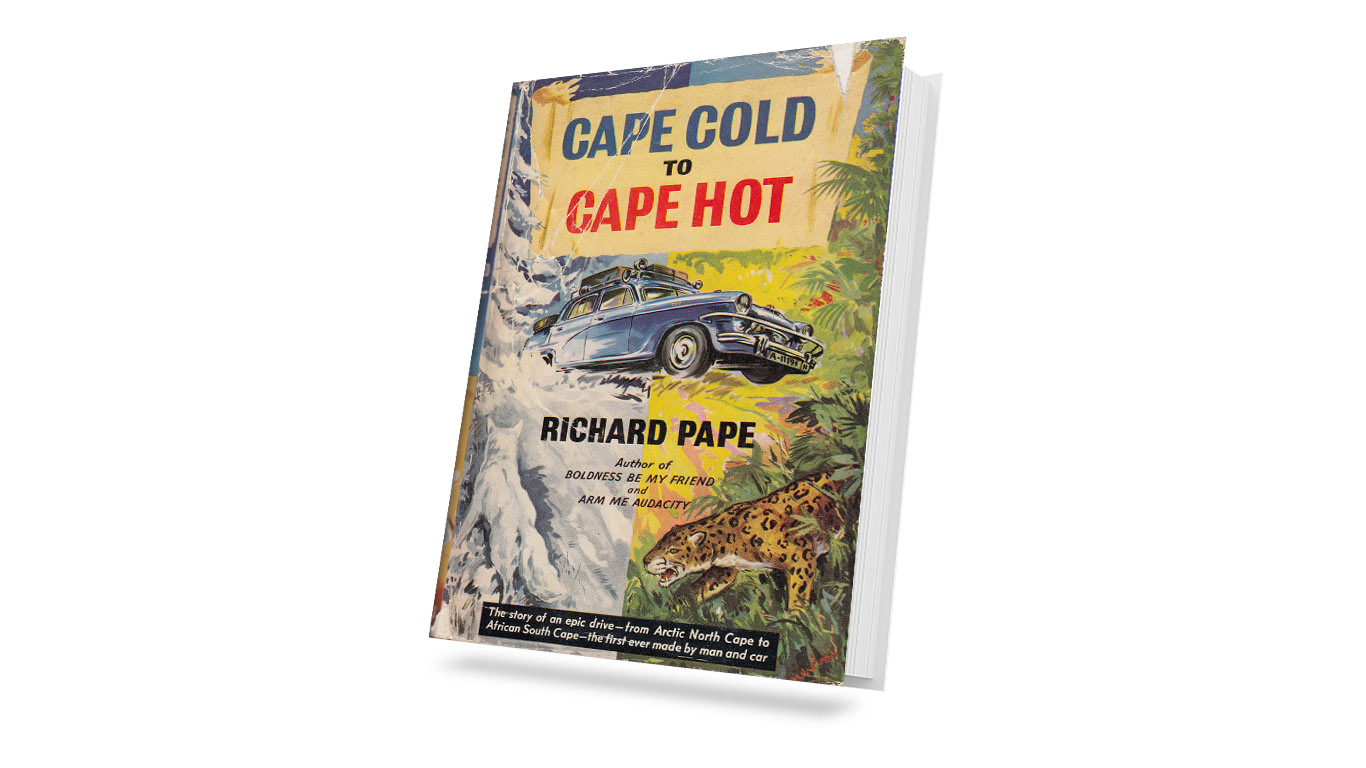
Richard Pape was certainly of adventurous nature. Predestined almost to accept the challenge to drive from the North Cape to Cape Town, a journey that was inconceivable at the time. And he did it in an Austin A90 for crying out loud—not even a 4×4. Oh my, he was faced with all sorts of problems along the way. And it’s in this spirit of raw, unadulterated adventure that we dive into his tale…
Richard Pape, that red-haired Yorkshireman with a glint in his eye and devil-may-care attitude, accepted the challenge and succeeded. Cape Cold to Cape Hot isn’t just a travelogue, it’s a full-throttle assault on the senses, a headlong plunge into the heart of adventure, and a bloody good read for anyone who’s ever felt the call of the wild. But more than that, it’s a stark reminder of what can be achieved with sheer grit, gumption, and a motor that’s more reliable than it is fancy.
The story begins when Pape’s just back from his “Cape to Cape” adventure, and he’s feeling it. Not all sunshine and roses, this homecoming. He’s restless, edgy, and London’s getting on his wick. This section lays down the genesis of the whole damn fool idea: a meeting with a Norwegian publisher, Reenskaug, who plants the seed of driving an Austin A90 from Norway’s North Cape to Cape Town. It’s a mad plan, fraught with peril, bureaucratic bollocks, and the kind of logistical nightmares that’d make lesser men weep into their whisky.
Turning the dream into reality is proving to be a right old slog. He’s battling bureaucratic red tape, dodging doomsayers, and trying to find a motor that’s up to the task. Then, just when things are looking bleak, a few glimmers of hope appear: Wakefield Oil throws him a lifeline, and a co-driver, Gunnar Melle, offers his services. But as any seasoned traveller knows, the road to hell is paved with good intentions, and Pape’s about to find out that the biggest challenges are often the ones you don’t see coming.
Richard Pape: Still the same stubborn, driven Yorkshireman, but we’re starting to see the cracks in his armour. The weight of the task is bearing down on him, and he’s prone to bouts of self-doubt and the occasional whisky-fuelled rant. But beneath it all, there’s a core of steel that refuses to be broken.
Gunnar Melle: A tough Norwegian photographer with a reputation for courage. He’s eager to join the expedition, but Pape senses a clash of personalities. Melle’s ambition and drive are undeniable, but Pape’s not sure he can trust him.
Willy Krögenes: A young, enthusiastic employee of Wakefield Oil who offers Pape crucial support and assistance. He embodies the spirit of Norwegian hospitality and becomes a trusted ally in Pape’s quest.
This section delves deeper into the themes of ambition, rivalry, and the challenges of leadership. Pape’s determination to be the first to drive from North Cape to Cape Town is unwavering, but he’s forced to make difficult decisions along the way, including the controversial sacking of Melle. The book also explores the importance of camaraderie and the bonds forged in the face of adversity, as Pape finds unexpected support from strangers and rediscovers the value of friendship.
But perhaps the most striking theme is the contrast between the simplicity of Pape’s gear and the over-engineered, marketing-driven world of modern overlanding. This journey took place in the mid-1950s, a time when 4x4s were a far cry from the luxurious, tech-laden beasts we see plastered across Instagram today. Pape’s Austin A90, for all its modifications, was still a relatively basic machine, relying more on the driver’s skill and ingenuity than on fancy gadgets and gizmos.
It’s a timely reminder that adventure isn’t about having the latest and greatest kit; it’s about having the courage to step outside your comfort zone and embrace the unknown. As Pape himself puts it, “I had confidence in myself and this matched investment in an ordinary stock model British motor-car.” He believed in the machine, but more importantly, he believed in himself.
Pape’s writing remains as engaging and direct as ever, but there’s a growing sense of urgency and desperation. The descriptions of the preparations are vivid and immersive, and the dialogue crackles with energy. He’s not afraid to lay bare his own flaws and insecurities, making him a relatable and compelling narrator.
“The Cape to Cape trip is not feasible,” I blurted out. “Mechanically, physically and financially it’s asking too much of man and machine. Count me out; I quit; I fly to Cape Town; eat, sleep and save money.”* – Pape’s moment of doubt, highlighting the sheer scale of the challenge.
“If I can’t drive with you, Pape, I’ll drive against you all the way, and I’ll beat you.” – Melle’s defiant words, foreshadowing the rivalry that will drive him to pursue his own “Cape to Cape” adventure.
“I think you have a pretty good idea, Gunnar, that I propose breaking into the Sahara if no permission is granted, and if I can get to North Africa. What about you, and your wife and three kids?” – Pape’s willingness to break the rules, and the moral dilemma it presents.
“Britain during the war put everything mechanical and physical into the effort to ensure victory, and the independence of occupied countries. To-day, to assist Britain’s industrial export recovery programme, it is essential that friendly foreign states buy British, especially motor-cars.” – Reenskaug’s patriotic appeal, highlighting the economic and political context of Pape’s adventure.
Strengths: The narrative tension is ratcheted up a notch, with Pape facing increasing obstacles and difficult choices. The character development is strong, and the descriptions of the preparations are fascinating. The added perspective on the gear and the contrast with modern overlanding adds depth and relevance.
Weaknesses: The sacking of Melle still feels a bit rushed, and it would have been interesting to explore that relationship in more depth.
“Cape Cold to Cape Hot” continues to deliver the goods, offering a thrilling glimpse into the world of overlanding and the mind of a man obsessed with adventure. This documentation is a rollercoaster of emotions, from the highs of securing sponsorship to the lows of personal conflict and bureaucratic roadblocks. But it’s also a testament to the power of human ingenuity and the enduring appeal of a good, old-fashioned adventure. If you’re looking for a book that will inspire you to pack your bags, ditch the fancy gadgets, and hit the open road, then look no further. Just be prepared for a bumpy ride, and remember that the best gear is the gear that gets you there.
“Cape Cold to Cape Hot” is out of print, but you can find good used examples at very fair prices on the usual online platforms.